
Bitcoin
Bitcoin: More Than 11 Million Coins Have No Identified Owner

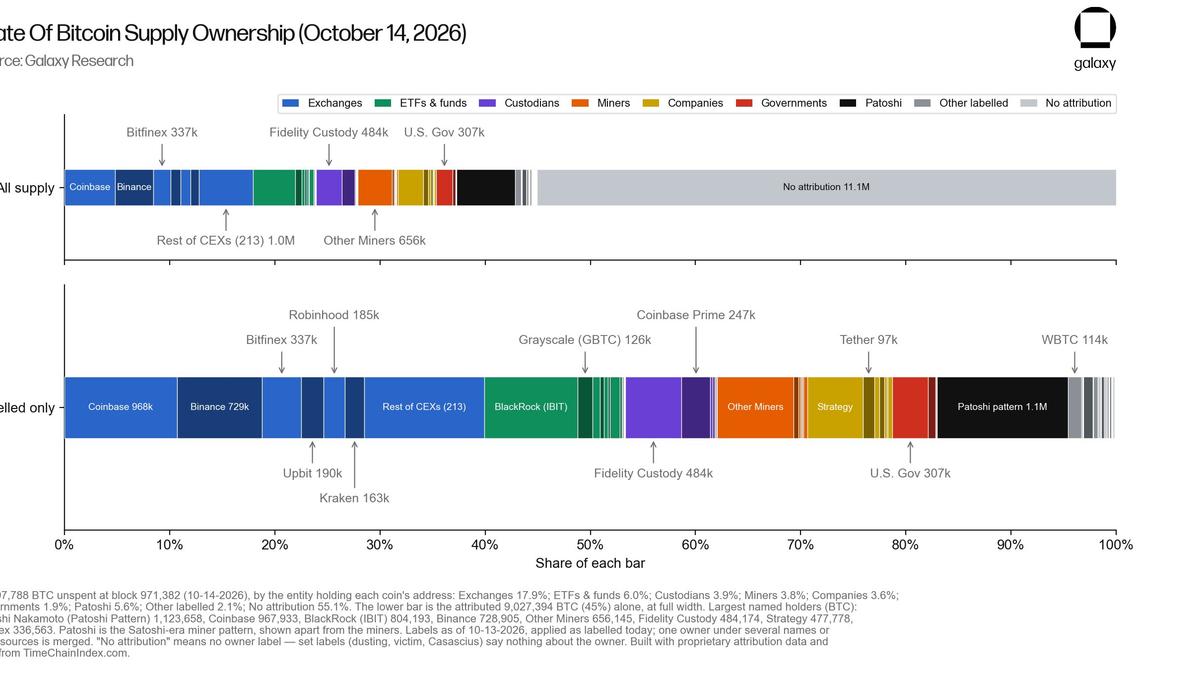
More than 11 million bitcoin are held in wallets whose owners cannot be identified publicly, a figure that offers an unusual view of how widely the cryptocurrency has been accumulated over time while also highlighting the limits of blockchain analysis.
The presence of such a large pool of unidentified holdings suggests that bitcoin ownership is not confined to a small group of recent market participants. Observers say the data is consistent with sustained involvement from retail investors, many of whom may have bought coins years ago and left them untouched rather than trading actively.
That interpretation, however, requires caution. A Bitcoin address is not the same thing as a person, company or institution. The blockchain records transactions and balances, but it does not attach legal names or verified identities to addresses. As a result, a wallet with a large or long-standing balance cannot automatically be classified as belonging to an individual investor.
The 11-million-plus estimate generally refers to coins associated with wallets whose ownership has not been established through public records, exchange disclosures or blockchain investigations. Some of those wallets may belong to private investors. Others could be controlled by companies, investment funds, miners, custodians or cryptocurrency exchanges that hold assets on behalf of thousands or millions of customers.
This distinction is particularly important because exchanges commonly combine customer deposits in shared addresses. A single address may therefore represent the holdings of a broad user base rather than one wealthy owner. Similarly, custodial platforms can move assets between wallets for operational or security reasons, making it difficult to determine how many underlying customers are represented by a particular balance.
The apparent age of the coins can provide additional clues, but it does not settle the question. Bitcoin transactions allow analysts to see when coins were last moved. Long periods of inactivity may indicate that an investor is holding for the long term, has lost access to the wallet or has died without leaving recovery instructions. In some cases, the coins may simply be stored offline and moved only rarely.
Coins that have remained dormant for years are sometimes described as “lost,” but that label is not always reliable. There is no public mechanism that can definitively distinguish an inaccessible wallet from one controlled by an owner who has chosen not to spend. A private key could be recovered after a long period, or a holder could decide to move coins after a decade of silence. Until that happens, the balance remains visible but its status is uncertain.
The opposite is also true: an address that appears active does not necessarily reveal the identity or motivation of its controller. It may be used for routine transfers by an exchange, for internal accounting by a custodian or for moving funds between cold-storage locations. Blockchain data can reveal patterns, but interpretation depends on assumptions about how wallets are grouped and how services manage their reserves.
Even with those limitations, the scale of unidentified ownership remains significant. Bitcoin’s protocol caps the eventual supply at 21 million coins, meaning that more than 11 million represents a substantial portion of all bitcoin that can ever exist. The estimate therefore points to a market in which a considerable amount of supply is not linked publicly to a known person or organization.
It also complicates attempts to measure the amount of bitcoin that is actually available for trading. The number of coins recorded on the blockchain is not the same as the number readily offered for sale. Long-term holders may have no intention of selling, while lost coins may never return to circulation. Exchange reserves and other identifiable holdings provide only part of the picture, and the boundary between liquid and illiquid supply can change when dormant addresses become active.
The data may nevertheless support the broader view that bitcoin has developed through years of participation rather than being built entirely on short-term speculation. Early adopters, smaller buyers and long-term holders accumulated coins during periods when the asset was less established and market access was more limited. Many may have retained their holdings through multiple price cycles.
But the ownership question cannot be answered from wallet balances alone. Analysts must account for address reuse, transfers between related wallets, exchange custody, lost keys and privacy practices before drawing conclusions about the number of individuals involved. A million coins spread across thousands of addresses could represent a huge community of holders, a limited number of professional entities or a mixture of both.
The uncertainty is part of the character of Bitcoin itself. Its ledger is transparent about movement, supply and transaction history, yet deliberately limited in what it reveals about the people behind each address. That combination makes it possible to study the distribution and age of the coins while leaving the ultimate owners unknown.
As a result, the more than 11 million bitcoin tied to unidentified wallets should be viewed as an important indicator, not a definitive census of retail ownership. The figure suggests deep and long-running participation in the market, but it cannot by itself prove who holds those coins, how many people are represented or how much of the supply may eventually return to circulation.

Bitcoin: More Than 11 Million Coins Have No Identified Owner

Beyond Crypto Trading: How PLUS Mainnet Is Building Toward the Next Phase of Blockchain Finance
California Challenges SEC Crypto Plan, Citing Threats to Investor Protection

Gaming Technologies of the New Time!

Calls for Enhanced Discussion on Bitcoin as Brazil’s Reserve Asset: A Move Towards ‘Internet’s Gold’

Bitcoin Declines Below $80K: deVere CEO Nigel Green Remains Bullish on Long-Term Outlook Following Strategic U.S. Bitcoin Reserve Announcement
-
 Press Releases2 years ago
Gaming Technologies of the New Time!
-
 Altcoins2 years ago
Calls for Enhanced Discussion on Bitcoin as Brazil’s Reserve Asset: A Move Towards ‘Internet’s Gold’
-
 Altcoins2 years ago
Bitcoin Declines Below $80K: deVere CEO Nigel Green Remains Bullish on Long-Term Outlook Following Strategic U.S. Bitcoin Reserve Announcement
-

 Bitcoin2 years ago
Bitcoin Surges Past $64K as SEI and POPCAT Lead Daily Crypto Gains on September 25
-

 Bitcoin1 year ago
Peter Schiff เตือนนักลงทุนคริปโตขาย Ethereum (ETH) เพื่อซื้อ Bitcoin ชี้ ETH มีศักยภาพจำกัด
-

 Bitcoin1 year ago
Strategy ขยายการถือครองบิตคอยน์สู่ 580,955 BTC หลังจากการซื้อใหม่มูลค่าหลายล้านดอลลาร์
-

 Press Releases2 years ago
Evo Exchange: Redefining the Decentralized Exchange Landscape
-

 Altcoins2 years ago
FBI เชื่อมโยงนักแสดงเกาหลีเข้ากับการแฮ็ก DMM Exchange มูลค่า 308 ล้านดอลลาร์