
Bitcoin
Electrum Wallet Attack Concealed Bitcoin Theft Through Inflated Fees

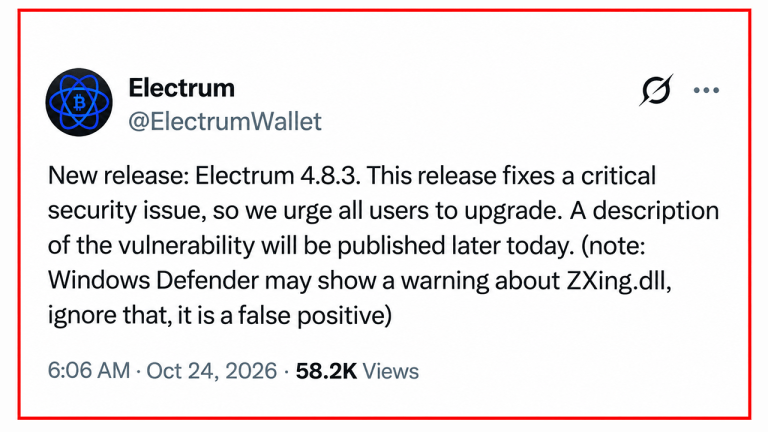
A security flaw in the Electrum Bitcoin wallet allowed a malicious server to disguise a theft as an ordinary transaction-fee increase, potentially persuading users to approve payments that redirected their funds to an attacker. Electrum has released version 4.8.3 to close the vulnerability after the weakness was exploited and Bitcoin was stolen.
The attack relied on the way Electrum wallets communicate with remote servers. Electrum is a lightweight Bitcoin wallet, meaning it does not independently download and verify the entire Bitcoin blockchain. Instead, it connects to servers that provide information about wallet balances, transaction history and the status of payments. That design makes the wallet faster and less demanding to operate, but it also means the software must carefully distinguish between legitimate server instructions and data that could be manipulated.
According to the security warning accompanying the update, a hostile server could interfere with a transaction during the process of increasing its fee. Bitcoin users may choose to raise a transaction fee when a payment is waiting too long to be confirmed. A higher fee can make the transaction more attractive to miners and help it move through the network more quickly, particularly when the blockchain is busy.
In the attack described by Electrum, however, the fee-bump process became a cover for replacing the intended payment. Rather than merely presenting the user with a modified fee for the same transaction, the malicious server could substitute a different transaction, one that sent the Bitcoin to an address controlled by the attacker. The wallet owner could then be shown what appeared to be a routine request to approve a higher fee.
That distinction is critical. A transaction fee normally changes the amount paid to miners while preserving the payment’s intended recipient. A replacement transaction that changes the recipient is fundamentally different: it redirects the coins themselves. If a user approved the fraudulent transaction, the attacker’s payment could be signed and broadcast to the Bitcoin network.
Bitcoin transactions are generally irreversible once confirmed. Unlike a bank transfer or card payment, a completed transaction cannot ordinarily be recalled by the wallet provider or reversed through a central administrator. That makes deception at the approval stage particularly serious. The user may believe they are authorizing a small adjustment, while the software is actually asking them to authorize the transfer of the underlying funds.
Electrum’s latest patch is intended to prevent the server from exploiting that mismatch between the transaction a user believes they are approving and the transaction the wallet is preparing to sign. The release, version 4.8.3, was announced on Saturday. Electrum warned users about the issue and urged them to install the corrected version.
The incident also illustrates a broader security challenge faced by lightweight cryptocurrency wallets. Users often focus on protecting seed phrases and private keys, which remain the most important credentials in a self-custodied wallet. Yet a wallet can still expose users to risk if its interface does not accurately display the transaction details being signed or if it places too much trust in information supplied by an external server.
A private key may remain secure throughout an attack of this kind. The theft does not necessarily require the attacker to obtain the key or break the cryptography protecting the wallet. Instead, the attacker attempts to manipulate the information presented to the owner and induce the owner to authorize a transaction voluntarily. In that sense, the weakness sits at the boundary between wallet software, server communications and user approval.
The episode reinforces the importance of examining the recipient address and total amount whenever a Bitcoin wallet requests confirmation, including when the request is described as a fee adjustment. Users should be cautious if a transaction they already approved appears to require unexpected additional action, particularly when the requested change is presented by a server rather than initiated directly by the wallet owner.
Updating the application is the primary protection provided by Electrum’s release. Users who continue running an earlier version may remain exposed to the flaw in circumstances where a malicious server can influence the fee-increase workflow. Because Electrum relies on a network of servers rather than a single centralized service, users should also avoid assuming that a familiar wallet interface guarantees that every server response is trustworthy.
The vulnerability highlights the practical limits of convenience features in a system designed to eliminate intermediaries. Fee increases can be useful for speeding up delayed Bitcoin payments, but they also create an additional transaction-management step that must be handled securely. Electrum’s version 4.8.3 update is designed to ensure that this step cannot be quietly turned into an opportunity to replace a legitimate payment with one benefiting a thief.

Electrum Wallet Attack Concealed Bitcoin Theft Through Inflated Fees
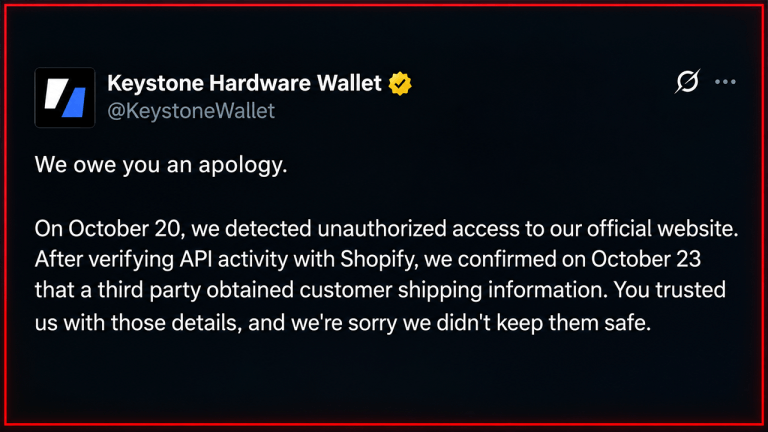
Keystone Security Breach Reveals Customer Addresses, Raising Scam Risks

Strategy and Strive Weigh Bitcoin Purchases Against Preferred-Stock Dividend Obligations

Gaming Technologies of the New Time!

Calls for Enhanced Discussion on Bitcoin as Brazil’s Reserve Asset: A Move Towards ‘Internet’s Gold’

Bitcoin Declines Below $80K: deVere CEO Nigel Green Remains Bullish on Long-Term Outlook Following Strategic U.S. Bitcoin Reserve Announcement
-
 Press Releases2 years ago
Gaming Technologies of the New Time!
-
 Altcoins2 years ago
Calls for Enhanced Discussion on Bitcoin as Brazil’s Reserve Asset: A Move Towards ‘Internet’s Gold’
-
 Altcoins2 years ago
Bitcoin Declines Below $80K: deVere CEO Nigel Green Remains Bullish on Long-Term Outlook Following Strategic U.S. Bitcoin Reserve Announcement
-

 Bitcoin2 years ago
Bitcoin Surges Past $64K as SEI and POPCAT Lead Daily Crypto Gains on September 25
-

 Bitcoin1 year ago
Peter Schiff เตือนนักลงทุนคริปโตขาย Ethereum (ETH) เพื่อซื้อ Bitcoin ชี้ ETH มีศักยภาพจำกัด
-

 Bitcoin1 year ago
Strategy ขยายการถือครองบิตคอยน์สู่ 580,955 BTC หลังจากการซื้อใหม่มูลค่าหลายล้านดอลลาร์
-

 Press Releases2 years ago
Evo Exchange: Redefining the Decentralized Exchange Landscape
-

 Altcoins2 years ago
FBI เชื่อมโยงนักแสดงเกาหลีเข้ากับการแฮ็ก DMM Exchange มูลค่า 308 ล้านดอลลาร์