
Bitcoin
Bitcoin Steadies Near $81K as Analysts Signal a Possible Market Floor

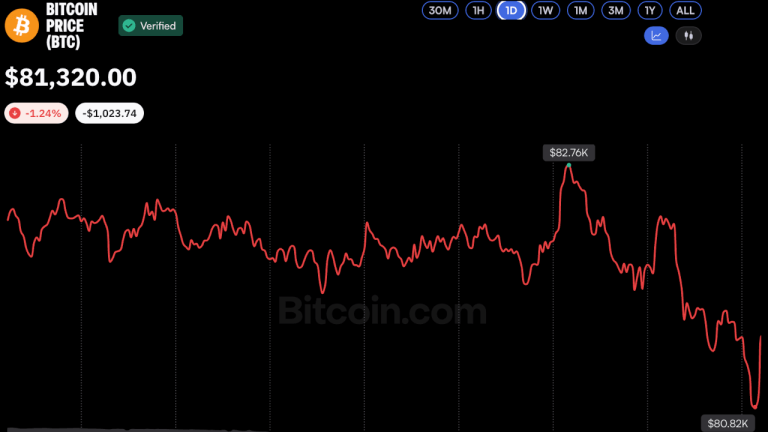
Bitcoin was trading near $81,000 on Oct. 16 after slipping below that level in a volatile session, as market participants assessed whether the latest decline represented a temporary pullback or the formation of a local market bottom.
The cryptocurrency had briefly reclaimed momentum earlier in the week, reversing a downward move that had pushed its price below $80,000 for the first time in several weeks. That recovery proved short-lived. Roughly a day after the reversal, Bitcoin fell back through the $82,000 threshold and then moved below $81,000, underscoring how quickly sentiment has been changing across the market.
The retreat has not, however, prompted a uniformly bearish response from analysts. Some market observers believe the recent weakness may be approaching a point of exhaustion, creating the possibility of a local bottom. In market terminology, a local bottom does not necessarily mark the end of a broader decline. It refers to a temporary low from which prices may stabilize or rebound before the next significant move becomes clear.
That distinction is important for Bitcoin traders. A sharp recovery from a recent low can signal that selling pressure is easing, but it can also represent a short-lived reaction within a larger downtrend. The price action around the $80,000 to $82,000 area is therefore likely to remain closely watched, particularly after Bitcoin moved through both levels in opposite directions within a relatively brief period.
Bitcoin’s drop below $80,000 earlier in the week marked a notable change in the market’s near-term tone. The level had held above that range for several weeks, making the break an important psychological event for traders. Once the cryptocurrency recovered from that decline, some participants interpreted the rebound as evidence that buyers were willing to defend lower prices. The subsequent move back under $82,000 has complicated that interpretation, leaving the market without a clear directional signal.
Volatility has been the central feature of the latest trading activity. Rapid advances and declines can reflect competing expectations among investors, with some using price weakness to accumulate while others reduce exposure when key support levels fail. In such conditions, a single recovery candle or brief move above a resistance level is generally not enough to establish a lasting trend. Traders often look for sustained buying, repeated successful tests of support and stronger follow-through before treating a rebound as more than a technical reaction.
The $81,000 area has consequently become a reference point for short-term sentiment. Holding near that level could allow Bitcoin to consolidate after its recent swings and give buyers time to rebuild momentum. A deeper move lower, by contrast, could revive concerns that the market has not yet found a durable floor. Neither outcome is guaranteed by the latest trading pattern, and analysts’ suggestion of a possible bottom remains conditional rather than definitive.
The recent sequence also illustrates the difference between a market reversal and a confirmed trend change. Bitcoin’s midweek turn higher interrupted the decline and briefly improved the technical picture. Yet the loss of the $82,000 level soon afterward showed that sellers remained active. Until the cryptocurrency can maintain higher levels over a longer period, the reversal may be viewed as an early signal rather than proof that the broader weakness has ended.
For investors, the uncertainty raises the importance of separating short-term price movements from longer-term market decisions. A move of several thousand dollars can occur quickly in digital-asset markets, and emotional responses to such fluctuations can increase the risk of buying into a temporary rally or selling during a brief decline. Professional traders typically monitor price levels alongside trading activity, broader risk appetite and the strength of follow-through, although the source of the latest move cannot be established from price action alone.
Bitcoin’s position near $81,000 leaves the market at a pivotal but unresolved point. The cryptocurrency has recovered from a break below $80,000, yet it has also failed to hold the higher $82,000 threshold. That combination supports the cautious view that selling pressure may be moderating while offering no confirmation that a sustained advance is underway.
For now, analysts’ focus is likely to remain on whether Bitcoin can stabilize above the lower end of its recent range and reclaim lost ground with consistency. A durable hold could strengthen the case for a local bottom, while another decisive decline would suggest that the market still needs to search for support. Until that direction becomes clearer, Bitcoin is likely to remain sensitive to sharp swings and rapidly changing investor expectations.


Bitcoin Steadies Near $81K as Analysts Signal a Possible Market Floor

Deutsche Bank Advances Toward Institutional Bitcoin and Ether Custody Rollout

Why XRP Has Lagged Bitcoin and Ether in Delivering Returns to Holders

Gaming Technologies of the New Time!

Calls for Enhanced Discussion on Bitcoin as Brazil’s Reserve Asset: A Move Towards ‘Internet’s Gold’

Bitcoin Declines Below $80K: deVere CEO Nigel Green Remains Bullish on Long-Term Outlook Following Strategic U.S. Bitcoin Reserve Announcement
-
 Press Releases2 years ago
Gaming Technologies of the New Time!
-
 Altcoins2 years ago
Calls for Enhanced Discussion on Bitcoin as Brazil’s Reserve Asset: A Move Towards ‘Internet’s Gold’
-
 Altcoins2 years ago
Bitcoin Declines Below $80K: deVere CEO Nigel Green Remains Bullish on Long-Term Outlook Following Strategic U.S. Bitcoin Reserve Announcement
-

 Bitcoin2 years ago
Bitcoin Surges Past $64K as SEI and POPCAT Lead Daily Crypto Gains on September 25
-

 Bitcoin1 year ago
Peter Schiff เตือนนักลงทุนคริปโตขาย Ethereum (ETH) เพื่อซื้อ Bitcoin ชี้ ETH มีศักยภาพจำกัด
-

 Press Releases2 years ago
Evo Exchange: Redefining the Decentralized Exchange Landscape
-

 Bitcoin1 year ago
Grayscale Investments Submits Draft Registration for IPO, Aiming for Public Trading in U.S.
-

 Press Releases2 years ago
CODE, a Newly Born Project Brings Decentralization Back to the Main Menu