
Bitcoin
Bitcoin Pulls Back From $85,000 as Tesla and Meta Fail to Ease AI Concerns

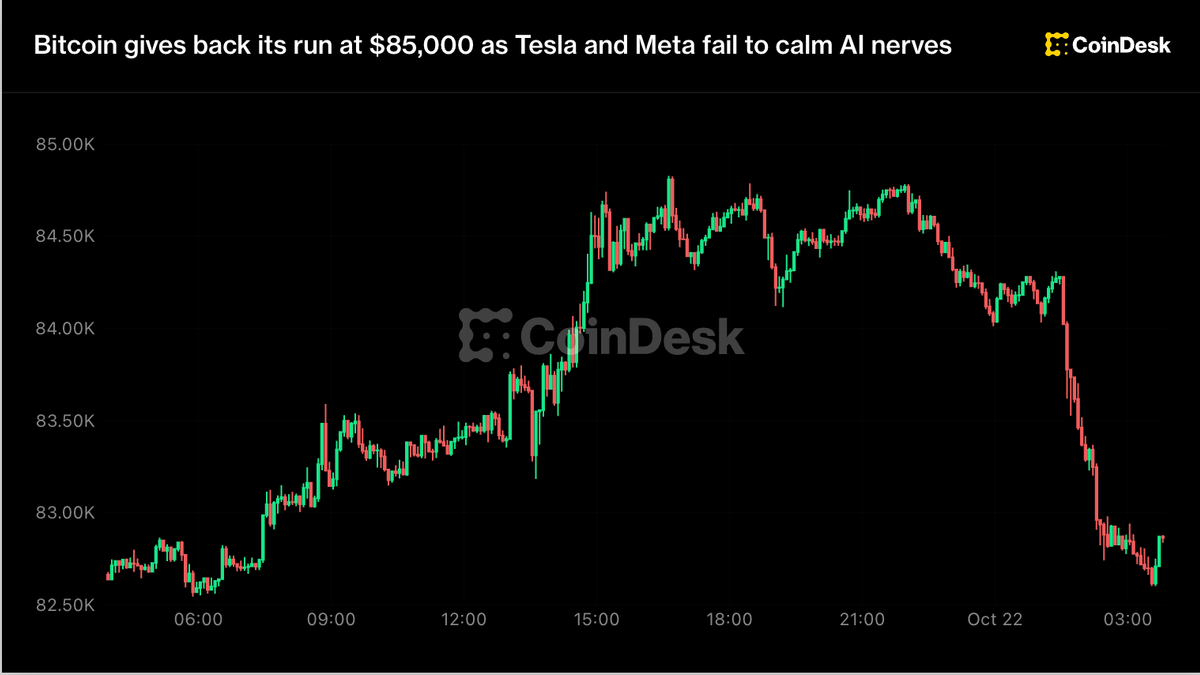
Bitcoin’s latest attempt to establish a foothold above $84,000 has faded, with the cryptocurrency retreating toward the $82,500 area as weakness in technology futures revived concerns about artificial-intelligence valuations and the broader appetite for risk.
Bitcoin moved through the $84,000 level late Wednesday, briefly suggesting that buyers were prepared to extend the advance. The move did not hold. Selling pressure returned soon afterward, pushing BTC back toward support that market analysts are now closely monitoring. The retreat places greater attention on whether the $82,500 region can absorb further selling or whether the failed breakout will encourage traders to reduce exposure more aggressively.
The pullback came as U.S. technology futures weakened. That broader market move mattered because bitcoin has increasingly traded alongside other risk-sensitive assets, particularly during periods when investors are reassessing the outlook for high-growth technology companies. A decline in technology futures can affect cryptocurrencies even when there is no immediate, bitcoin-specific development driving the market.
Tesla and Meta were among the companies investors looked to for reassurance as anxiety surrounding artificial-intelligence spending and valuations continued to influence sentiment. Their presence in the market discussion did not provide enough support to reverse the deterioration in risk appetite. Instead, the response suggested that investors remained cautious about whether the technology sector can sustain its recent momentum while questions about the scale and payoff of AI investment persist.
Bitcoin’s move illustrates the importance of nearby technical levels in a market that remains sensitive to changes in sentiment. The $84,000 area had acted as a ceiling before the latest break above it. Once the cryptocurrency slipped back below that level, traders’ focus shifted to $82,500, which is viewed as a more immediate test of demand. A sustained hold above that zone could leave the broader recovery structure intact, while a decisive break lower would weaken the case that the move through $84,000 represented the start of a durable advance.
Technical levels, however, do not operate independently of the wider market. Bitcoin trades continuously, unlike traditional U.S. equity markets, and can react rapidly to moves in futures contracts before the underlying stock exchanges open. That makes overnight and late-session price action especially important. A rise in Treasury yields, a decline in technology shares or a change in expectations for monetary policy can all influence cryptocurrency positioning, even if the original catalyst comes from outside the digital-asset market.
The renewed caution also reflects the way investors have grouped bitcoin with other speculative assets. During periods of confidence, that connection can help lift the cryptocurrency as traders seek exposure to growth themes and assets perceived to offer significant upside. When uncertainty rises, the same relationship can work in reverse. Investors may choose to lock in gains, reduce leverage or wait for clearer signals from equities before committing additional capital.
The latest retreat does not by itself establish a new downtrend. Bitcoin remains close enough to the recent breakout zone for buyers to attempt another recovery. Yet the inability to hold above $84,000 gives the market a more fragile appearance. Traders who entered during the move higher may now be watching closely for evidence that the decline is merely a pullback rather than a broader reversal.
The technology sector’s response to AI-related concerns will therefore remain relevant to bitcoin’s near-term direction. Investors are weighing the potential benefits of AI against the substantial capital required to develop and deploy the technology, while also questioning how quickly those investments will translate into earnings. Even without a direct connection between corporate AI spending and bitcoin’s underlying network, shifts in that debate can influence the overall willingness to hold volatile assets.
For now, the market is centered on whether bitcoin can stabilize near $82,500 after losing momentum above $84,000. A recovery back through the higher level would restore some of the confidence created by Wednesday’s breakout. Continued weakness in technology futures, by contrast, could keep pressure on the cryptocurrency and make the lower support level increasingly vulnerable. Tesla and Meta may have been unable to ease the market’s AI-related concerns, leaving bitcoin exposed to the same unsettled sentiment weighing on technology-linked assets.


Bitcoin Pulls Back From $85,000 as Tesla and Meta Fail to Ease AI Concerns
Kalshi Posts $19 Billion Weekly Volume as Non-Election Markets Drive Trading Surge

BIS Bitcoin Paper Criticized for Shallow Analysis While Echoing Saylor’s Core Argument

Gaming Technologies of the New Time!

Calls for Enhanced Discussion on Bitcoin as Brazil’s Reserve Asset: A Move Towards ‘Internet’s Gold’

Bitcoin Declines Below $80K: deVere CEO Nigel Green Remains Bullish on Long-Term Outlook Following Strategic U.S. Bitcoin Reserve Announcement
-
 Press Releases2 years ago
Gaming Technologies of the New Time!
-
 Altcoins2 years ago
Calls for Enhanced Discussion on Bitcoin as Brazil’s Reserve Asset: A Move Towards ‘Internet’s Gold’
-
 Altcoins2 years ago
Bitcoin Declines Below $80K: deVere CEO Nigel Green Remains Bullish on Long-Term Outlook Following Strategic U.S. Bitcoin Reserve Announcement
-

 Bitcoin2 years ago
Bitcoin Surges Past $64K as SEI and POPCAT Lead Daily Crypto Gains on September 25
-

 Bitcoin1 year ago
Peter Schiff เตือนนักลงทุนคริปโตขาย Ethereum (ETH) เพื่อซื้อ Bitcoin ชี้ ETH มีศักยภาพจำกัด
-

 Press Releases2 years ago
Evo Exchange: Redefining the Decentralized Exchange Landscape
-

 Bitcoin1 year ago
Strategy ขยายการถือครองบิตคอยน์สู่ 580,955 BTC หลังจากการซื้อใหม่มูลค่าหลายล้านดอลลาร์
-

 Bitcoin1 year ago
Grayscale Investments Submits Draft Registration for IPO, Aiming for Public Trading in U.S.