
Bitcoin
BIS Bitcoin Paper Criticized for Shallow Analysis While Echoing Saylor’s Core Argument

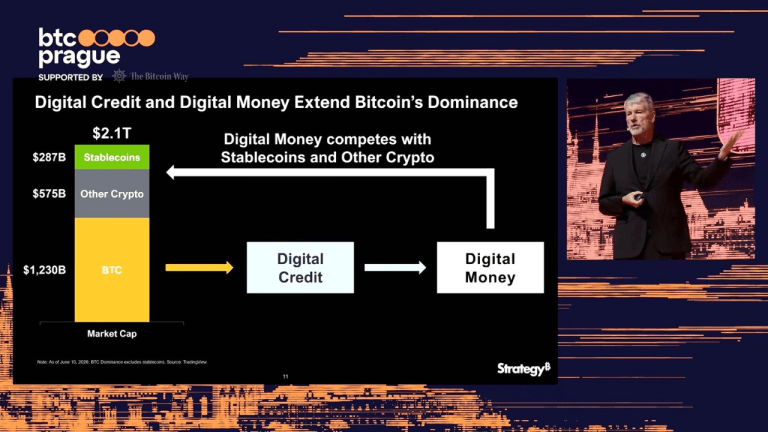
A new paper from the Bank for International Settlements has revived familiar criticisms of Bitcoin while reaching a conclusion that overlaps with one of the cryptocurrency’s most prominent corporate supporters: Bitcoin is not functioning as everyday money.
The agreement, however, ends there. The BIS paper approaches the issue from the perspective of monetary economics and the architecture of trust, while Michael Saylor, executive chairman of Strategy, has long argued from a position that treats Bitcoin primarily as a scarce digital asset and long-term store of value rather than a practical payment instrument.
The paper, titled “Money and the Architecture of Trust,” was published this month by the Basel-based institution, which serves as a forum and research center for central banks. Iñaki Aldasoro, an economist associated with the BIS, is among the contributors to the work. Its discussion of Bitcoin has drawn attention because critics say it repeats arguments that have circulated for years, including claims that have already been challenged by cryptocurrency researchers and advocates.
At the same time, the paper’s assessment of Bitcoin’s limited role in ordinary commerce coincides with Saylor’s public position. Saylor, whose company has accumulated a large Bitcoin treasury, has repeatedly distinguished between Bitcoin’s potential as a monetary asset and its usefulness for buying routine goods and services. His argument is not that Bitcoin has failed altogether, but that its most important function lies elsewhere.
That distinction is central to the debate over Bitcoin’s identity. The original cryptocurrency was introduced as a peer-to-peer electronic cash system, suggesting that users could transfer value directly without relying on banks or other intermediaries. In practice, Bitcoin’s volatility, transaction costs, settlement delays and limited acceptance have made it difficult to use for many everyday purchases. Consumers and merchants may be reluctant to price goods in an asset whose value can move sharply over short periods.
The BIS analysis appears to emphasize those practical limitations, presenting them as evidence of a deeper problem with Bitcoin’s monetary design. Critics of the paper argue that this framing is too familiar and does not adequately address the ways Bitcoin’s role has evolved since its launch. Rather than serving primarily as a digital substitute for cash, Bitcoin is increasingly discussed as a globally accessible, scarce asset that can be held outside the conventional financial system.
The distinction between a payment currency and a reserve-like asset is not merely semantic. Money typically performs several functions: it acts as a medium of exchange, a unit in which prices are set and a store of value. An asset can be useful in one of those roles without performing all three equally well. Gold, for example, has historically been treated as a store of value even though it is rarely used to settle ordinary retail transactions. Bitcoin supporters increasingly make a similar case for the cryptocurrency.
Saylor’s strategy reflects that interpretation. Strategy has made Bitcoin the centerpiece of its corporate treasury policy, using the asset as a long-term holding rather than as an instrument for settling the company’s routine operating expenses. His advocacy has focused on Bitcoin’s fixed supply, portability and resistance to direct control by any single government or institution. Those attributes, in his view, matter more than whether shoppers use Bitcoin to pay for coffee or groceries.
The BIS paper’s conclusion therefore creates an unusual point of convergence between an international institution associated with central banks and one of Bitcoin’s most vocal advocates. Both recognize that Bitcoin has not displaced national currencies in ordinary commerce. Their explanations differ sharply: the BIS perspective treats the absence of widespread everyday use as part of a broader critique of Bitcoin’s ability to operate as money, while Saylor regards it as confirmation that Bitcoin should be judged mainly as a monetary asset.
The disagreement also highlights a recurring tension in discussions about cryptocurrency. Evaluations often depend on the standard being applied. If Bitcoin is measured against the ideal of stable, convenient retail money, its shortcomings are readily apparent. If it is assessed as an asset that can be transferred globally without permission and held independently of traditional financial institutions, supporters point to a different set of qualities.
The paper’s critics say that presenting older objections as decisive risks overlooking this shift in how Bitcoin is used and marketed. Volatility, energy consumption, governance and transaction capacity remain subjects of serious debate, but the cryptocurrency’s supporters no longer necessarily claim that it must replace cash in every transaction to have value. Many instead argue that adoption can occur through investment, treasury management and settlement networks without requiring Bitcoin to become the default currency for daily purchases.
The BIS position still carries significance because the institution’s research can influence how policymakers and financial professionals assess digital assets. Its work frequently examines the relationship between technology, financial stability and monetary systems. A skeptical treatment of Bitcoin may reinforce the view among regulators that the asset is unsuitable as a direct replacement for sovereign money, even as market participants continue to use it for investment and speculation.
The apparent overlap with Saylor’s view does not resolve the larger debate. It does, however, clarify one point: Bitcoin’s future may not depend on becoming the currency used at every checkout counter. The more immediate question is whether it can establish a durable role as a digital store of value while addressing the economic and technical criticisms raised by institutions such as the BIS.


BIS Bitcoin Paper Criticized for Shallow Analysis While Echoing Saylor’s Core Argument

Unidentified Whale Moves $90 Million in Bitcoin Out of Wintermute

Zcash Developers Set November Upgrade to Triple Payment Speed

Gaming Technologies of the New Time!

Calls for Enhanced Discussion on Bitcoin as Brazil’s Reserve Asset: A Move Towards ‘Internet’s Gold’

Bitcoin Declines Below $80K: deVere CEO Nigel Green Remains Bullish on Long-Term Outlook Following Strategic U.S. Bitcoin Reserve Announcement
-
 Press Releases2 years ago
Gaming Technologies of the New Time!
-
 Altcoins2 years ago
Calls for Enhanced Discussion on Bitcoin as Brazil’s Reserve Asset: A Move Towards ‘Internet’s Gold’
-
 Altcoins2 years ago
Bitcoin Declines Below $80K: deVere CEO Nigel Green Remains Bullish on Long-Term Outlook Following Strategic U.S. Bitcoin Reserve Announcement
-

 Bitcoin2 years ago
Bitcoin Surges Past $64K as SEI and POPCAT Lead Daily Crypto Gains on September 25
-

 Bitcoin1 year ago
Peter Schiff เตือนนักลงทุนคริปโตขาย Ethereum (ETH) เพื่อซื้อ Bitcoin ชี้ ETH มีศักยภาพจำกัด
-

 Press Releases2 years ago
Evo Exchange: Redefining the Decentralized Exchange Landscape
-

 Bitcoin1 year ago
Strategy ขยายการถือครองบิตคอยน์สู่ 580,955 BTC หลังจากการซื้อใหม่มูลค่าหลายล้านดอลลาร์
-

 Bitcoin1 year ago
Grayscale Investments Submits Draft Registration for IPO, Aiming for Public Trading in U.S.