
Altcoins
Binance Takes $100 Million Stake in Circle as USDC Partnership Enters New Five-Year Phase

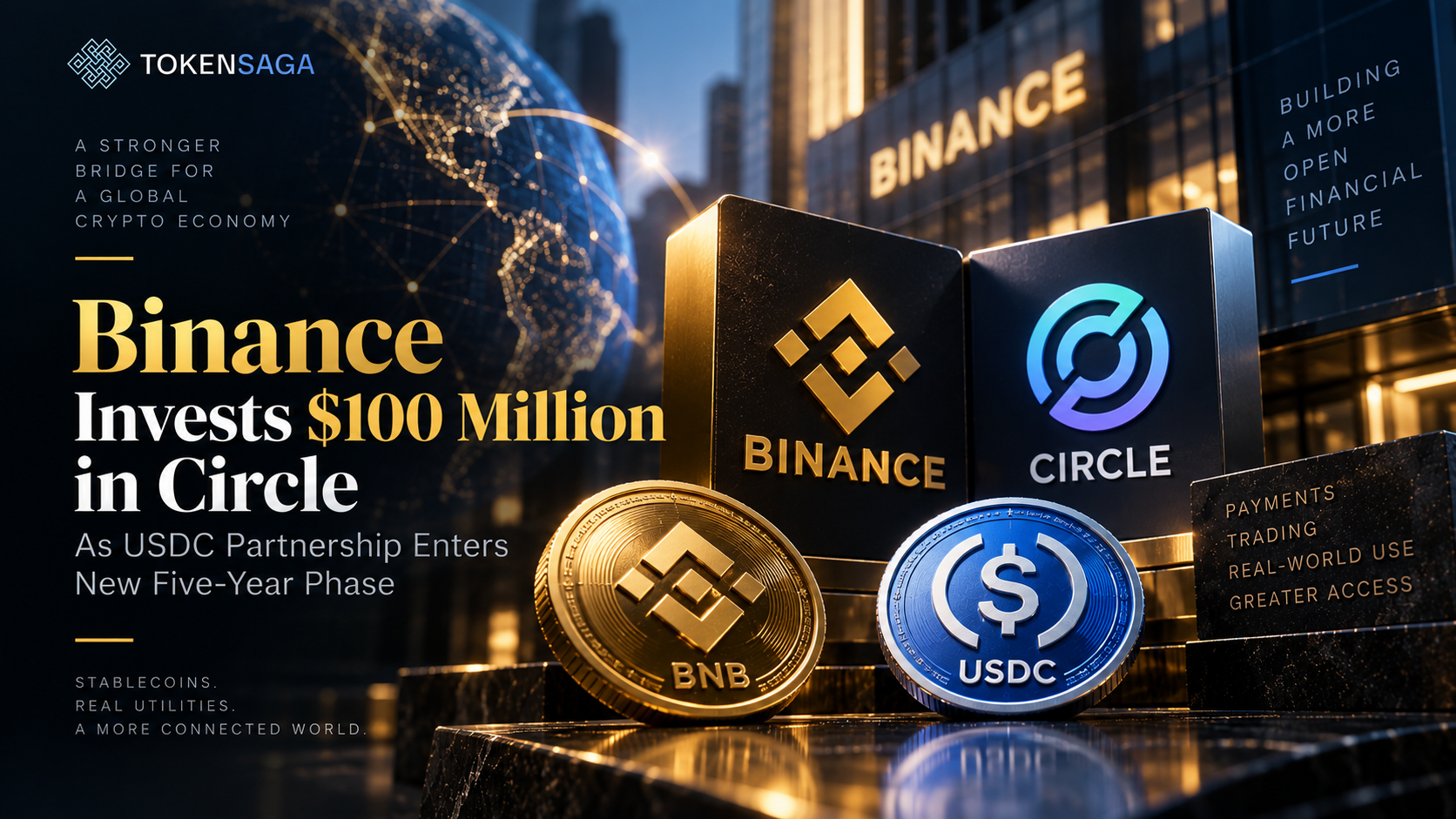
Binance is deepening its relationship with Circle, the company behind USDC, with a $100 million investment in the stablecoin issuer and a new five-year commercial agreement aimed at expanding USDC’s use across Binance’s global platform.
The deal, announced September 22, gives Binance an equity position in Circle while extending a relationship that has increasingly centered on the distribution and use of dollar-backed digital assets. Circle confirmed that Binance purchased 1,237,011 shares of its Class A common stock at $80.84 per share through a private placement.
The investment closed on September 17 alongside the expanded commercial agreement.
For Binance, the deal represents a deeper commitment to USDC at a time when stablecoins are becoming an increasingly important part of crypto trading, payments and digital financial infrastructure.
From Partnership to Ownership
Binance and Circle have worked together since 2024, but the latest agreement takes the relationship considerably further.
Under the new arrangement, Binance will promote and expand access to USDC across its platform, with particular attention to emerging markets. Circle will provide infrastructure supporting the holding and use of USDC.
The agreement also introduces a financial component tied to USDC usage.
Circle will pay Binance a monthly incentive fee calculated according to the amount of USDC held through Circle’s Modular Smart Contract Wallet infrastructure, according to the companies’ filings.
The new agreement replaces earlier commercial arrangements between the two companies dating from 2024 and 2025.
The five-year term does not necessarily mean the arrangement must run for the full period. The companies retain specified rights to terminate it early.
A $100 Million Bet on the Stablecoin Economy
The equity investment is perhaps the more striking part of the announcement.
Binance purchased its Circle shares at $80.84 each, with the transaction reflecting a discount to Circle’s market price before the deal. The exchange is also restricted from selling, transferring or hedging the shares for up to two years, subject to specified exceptions. Binance retains voting rights during that period.
The structure gives Binance an economic interest in the company whose stablecoin it is simultaneously agreeing to promote.
That creates a closer connection between the exchange’s business and USDC’s expansion than a conventional distribution agreement would provide.
Circle’s shares rose nearly 2% in premarket trading following the announcement, according to Reuters.
Why USDC Matters to Binance
Stablecoins sit at the center of much of the digital-asset economy.
Unlike volatile cryptocurrencies such as Bitcoin or BNB, dollar-backed stablecoins are designed to maintain a relatively stable value against the U.S. dollar. They are used across exchanges, decentralized applications, payments and settlement systems.
USDC has become one of the largest stablecoins in the market, with a supply of roughly $75 billion around the time of the announcement.
For an exchange operating across multiple markets, stablecoins are also more than a trading pair.
They can function as a settlement asset, a bridge between different cryptocurrencies and a way for users in markets with limited access to traditional dollar-based financial products to interact with digital dollars.
That makes distribution an important part of the stablecoin business.
Binance’s role is particularly significant because of the size of its global user base and the range of products offered through its platform.
The Emerging-Market Focus
Both companies have emphasized emerging markets as a major part of the expanded relationship.
Circle said the partnership is intended to increase access to USDC for users and businesses in developing markets, while Binance will focus on distribution and adoption through its platform.
The strategy reflects a broader shift in how stablecoins are being positioned.
What began primarily as a crypto-market settlement tool has increasingly become part of conversations around cross-border payments, savings, commerce and access to digital dollars.
For users and businesses operating across borders, a digital dollar can potentially move through blockchain networks without relying on the same infrastructure used by traditional international payments.
The practical usefulness of that model will ultimately depend on local regulation, liquidity and how widely businesses and consumers actually adopt it.
A Significant Change From Binance’s Earlier Stablecoin Strategy
The relationship between Binance and Circle has not always been this close.
In 2022, Binance reduced support for USDC while promoting its own dollar-linked stablecoin, BUSD. That strategy eventually changed after regulatory developments surrounding Paxos, the company that issued BUSD for Binance.
Binance and Circle subsequently moved toward cooperation, announcing a strategic partnership in 2024.
The latest agreement represents another step in that evolution.
Instead of competing around separate stablecoin ecosystems, Binance and Circle are now building a commercial relationship around USDC.
What It Means for the Binance Ecosystem
The announcement is directly about Binance and Circle rather than BNB itself, and there is no indication that the $100 million investment represents a direct purchase of BNB.
Its relevance to the broader BNB ecosystem comes from the role stablecoins play across Binance’s exchange and blockchain businesses.
More USDC activity can potentially mean more stablecoin liquidity available to traders and applications connected to Binance’s wider ecosystem. However, the investment itself does not establish that BNB holders will directly benefit from the deal.
That distinction is important.
The immediate development is a corporate and commercial agreement between Binance and Circle. Any eventual effect on BNB or BNB Chain activity would depend on how the partnership translates into actual user activity, liquidity and product usage.
The Bigger Story Is the Infrastructure
The Binance-Circle deal arrives as the cryptocurrency industry moves further toward a financial infrastructure built around stablecoins.
Exchanges want deeper stablecoin liquidity. Payment companies are experimenting with blockchain settlement. Financial institutions are exploring tokenized deposits and digital assets.
Against that backdrop, Binance’s decision to put $100 million into Circle is more than a partnership renewal.
It places one of the world’s largest crypto exchanges directly alongside one of the industry’s largest stablecoin issuers, with both companies committing to a five-year commercial relationship focused on expanding the reach of USDC.
For Binance, the next phase will be measured less by the announcement itself and more by how much USDC usage the expanded partnership generates across its platform and the markets it serves.


Ripple’s $24M XRP Dispute Threatens Its $400M Tranglo Stake

New York AG Wins Up to $35 Million Settlement and Lifetime Crypto Ban for Celsius Founder Alex Mashinsky

Kyrgyzstan Halts USDKG Stablecoin and Burns 50 Million Tokens

Gaming Technologies of the New Time!

Calls for Enhanced Discussion on Bitcoin as Brazil’s Reserve Asset: A Move Towards ‘Internet’s Gold’

Bitcoin Declines Below $80K: deVere CEO Nigel Green Remains Bullish on Long-Term Outlook Following Strategic U.S. Bitcoin Reserve Announcement
-
 Press Releases2 years ago
Gaming Technologies of the New Time!
-
 Altcoins2 years ago
Calls for Enhanced Discussion on Bitcoin as Brazil’s Reserve Asset: A Move Towards ‘Internet’s Gold’
-
 Altcoins2 years ago
Bitcoin Declines Below $80K: deVere CEO Nigel Green Remains Bullish on Long-Term Outlook Following Strategic U.S. Bitcoin Reserve Announcement
-

 Bitcoin2 years ago
Bitcoin Surges Past $64K as SEI and POPCAT Lead Daily Crypto Gains on September 25
-

 Press Releases2 years ago
Evo Exchange: Redefining the Decentralized Exchange Landscape
-

 Bitcoin1 year ago
Peter Schiff เตือนนักลงทุนคริปโตขาย Ethereum (ETH) เพื่อซื้อ Bitcoin ชี้ ETH มีศักยภาพจำกัด
-

 Bitcoin1 year ago
Grayscale Investments Submits Draft Registration for IPO, Aiming for Public Trading in U.S.
-

 Press Releases2 years ago
CODE, a Newly Born Project Brings Decentralization Back to the Main Menu