
Bitcoin
Bitcoin-Gold Correlation Reaches Record Level, Galaxy Research Reports

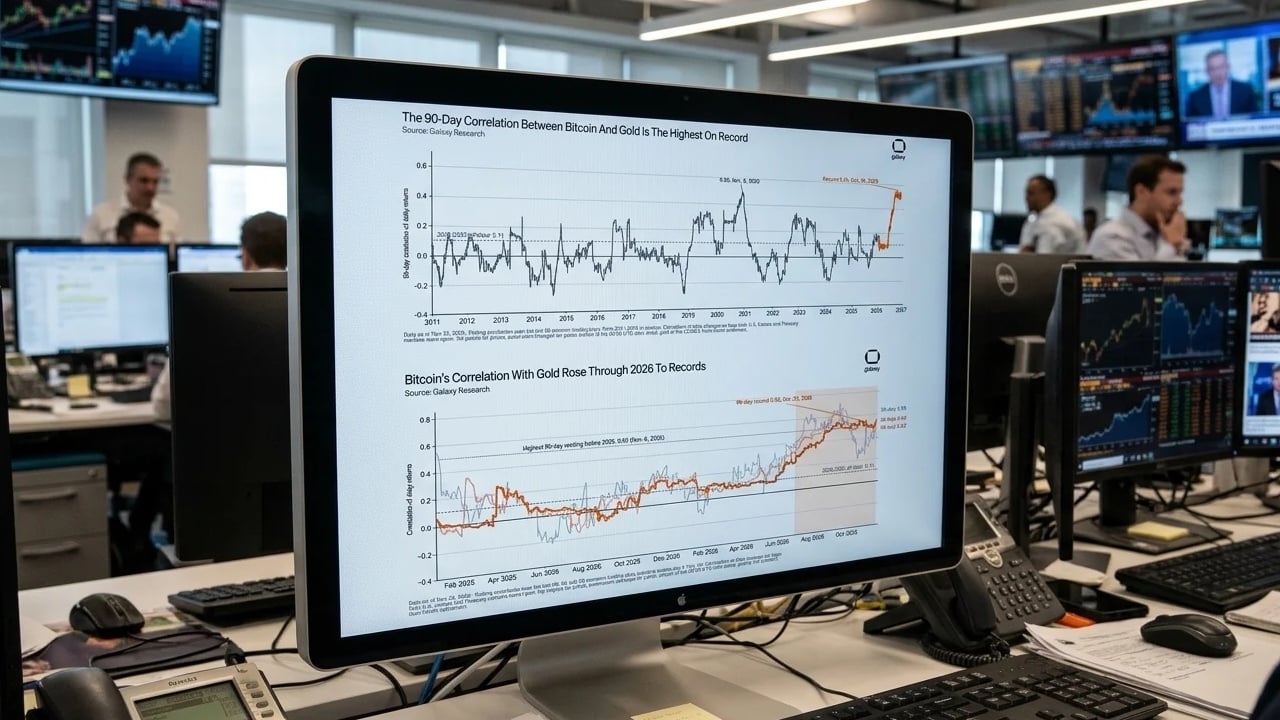
Bitcoin’s relationship with gold has reached its strongest level in Galaxy Research’s historical data, with the two assets’ daily price movements showing an unprecedented degree of similarity over a 90-trading-day period.
The finding, which covers data dating back to 2011, marks a notable development for an asset that has frequently been described as both a technology-driven financial instrument and a potential alternative store of value. Bitcoin and gold have often been compared because both are viewed by some investors as scarce assets outside the direct control of governments. Their prices, however, have not consistently moved together. The latest reading suggests that their behavior has aligned more closely than at any previous point in the research firm’s dataset.
Correlation measures the extent to which two assets move in relation to one another over a selected period. A high positive correlation means the assets have generally risen and fallen in the same direction, while a low or negative reading indicates weaker alignment or opposing movements. It does not establish that one asset caused the other to move, nor does it guarantee that the relationship will continue.
The 90-day measure is particularly significant because it captures several months of market activity rather than a short-lived daily coincidence. Even so, the result should be interpreted as a description of recent price behavior, not as proof that Bitcoin has permanently adopted the market characteristics of gold. Correlations can shift quickly when investors respond to changes in interest rates, inflation expectations, economic growth, liquidity or geopolitical risk.
Bitcoin’s comparison with gold has expanded as the cryptocurrency has become more established among professional investors. Gold has traditionally been used as a hedge against currency weakness, inflation and periods of financial stress. Bitcoin’s advocates have promoted similar arguments, pointing to its limited supply and decentralized design. Yet the two markets remain structurally different. Gold has a much longer history as a monetary and investment asset, while Bitcoin trades in a digital market influenced by technology adoption, regulatory developments, exchange activity and changes in investor sentiment.
Those differences have often produced divergent price behavior. Bitcoin can experience sharp moves within a single day and has historically been more sensitive to shifts in risk appetite than gold. When investors favor speculative or growth-oriented assets, Bitcoin may benefit disproportionately. During periods of market strain, it can also fall more abruptly as traders reduce exposure to volatile positions. Gold, by contrast, is widely held by central banks, institutional investors and households, giving its market a different composition and trading history.
The latest Galaxy Research observation indicates that these distinctions have not prevented the assets from responding similarly during the period measured. A common macroeconomic backdrop may help explain why. Investors frequently reassess both assets when expectations change around inflation, monetary policy, real yields and the broader value of fiat currencies. When those forces dominate trading decisions, assets associated with scarcity or monetary protection can move in the same direction.
However, the correlation does not mean Bitcoin has become a direct substitute for gold. The two assets continue to differ in liquidity, market size, custody arrangements, regulation and volatility. Gold can be purchased through physical bullion, exchange-traded products, futures and other established channels. Bitcoin exposure is typically obtained through digital-asset platforms, regulated investment products or direct ownership through a wallet. These differing access points can attract separate groups of investors and create different patterns of buying and selling.
The 2011 starting point also places the finding in the context of Bitcoin’s changing market profile. At that time, Bitcoin was a relatively young asset with limited mainstream participation and a much smaller trading ecosystem. Since then, its market has expanded, drawing greater attention from financial institutions and professional researchers. Comparing current price behavior with the full period therefore captures not only changing market conditions but also the evolution of Bitcoin itself.
For investors, the record correlation may strengthen the case for examining Bitcoin alongside traditional stores of value rather than treating it solely as a technology or speculative asset. It does not eliminate the risks associated with cryptocurrency markets, nor does it provide a reliable signal about future returns. A relationship that appears strong over 90 trading days can weaken or reverse as market leadership changes.
Galaxy Research’s finding is therefore best understood as an important snapshot of market behavior. Bitcoin and gold have moved more closely together over the measured period than at any other time in the firm’s data since 2011, but whether that alignment becomes a lasting feature of the two markets will depend on how investors respond to the next shifts in economic conditions and financial sentiment.


-

 Press Releases2 years ago
Gaming Technologies of the New Time!
-

 Altcoins2 years ago
Bybit announces it will stop withdrawing services in France from January 8, 2025 after regulatory changes
-

 Altcoins2 years ago
FBI เชื่อมโยงนักแสดงเกาหลีเข้ากับการแฮ็ก DMM Exchange มูลค่า 308 ล้านดอลลาร์
-

 Altcoins2 years ago
Calls for Enhanced Discussion on Bitcoin as Brazil’s Reserve Asset: A Move Towards ‘Internet’s Gold’
-

 Bitcoin2 years ago
5 สกุลเงินคริปโตที่ควรซื้อ เมื่อบริษัท MicroStrategy ของจีนเริ่มสะสม Bitcoin
-

 Bitcoin2 years ago
Bitcoin ETF ประสบปัญหาใหญ่ออกเงินสูงถึง 1 พันล้านดอลลาร์ในวันเดียว
-

 Bitcoin1 year ago
Peter Schiff เตือนนักลงทุนคริปโตขาย Ethereum (ETH) เพื่อซื้อ Bitcoin ชี้ ETH มีศักยภาพจำกัด
-
 Altcoins2 years ago
Gemini ประกาศเพิ่มการซื้อขายเหรียญ Stablecoin RLUSD ของ Ripple