
Bitcoin
Bitcoin Supply in the Red Surpasses 2022 Bear-Market Levels, Analyst Says

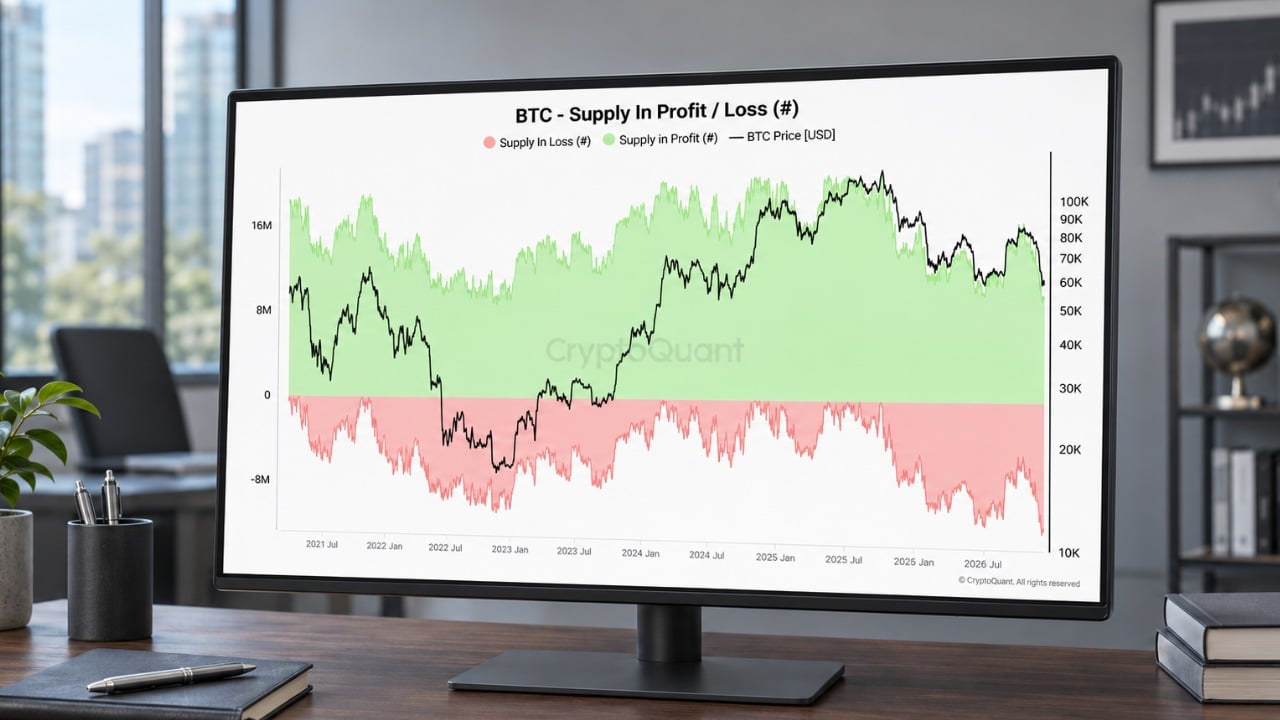
More than half of Bitcoin’s measured supply was sitting at an unrealized loss, according to an analysis that counted coins that have remained inactive for long periods as well as holdings that may effectively be lost.
The finding places the share of Bitcoin held below its acquisition price above levels associated with the 2022 bear market, when the cryptocurrency suffered a prolonged decline from its previous record high. It also highlights how the way analysts define “supply” can significantly affect the picture presented by on-chain data.
A coin is considered to be held at a paper loss when its most recent recorded movement occurred at a price above Bitcoin’s current market value. The loss remains unrealized because the holder has not necessarily sold the asset. If the coin is later transferred or sold at a higher price, the apparent loss can narrow or disappear. Conversely, a sale at a lower value would turn the paper loss into a realized one.
The analysis did not restrict its assessment to coins that are actively circulating among traders. It included dormant balances and coins that may no longer be accessible, such as holdings connected to lost private keys. That broader approach can push the proportion of supply at a loss higher than measures based only on recently active coins.
Bitcoin’s blockchain records when individual units move, but it does not reveal whether a holder is still able to access them or why a transaction took place. A coin that has not moved for years may belong to a long-term investor who remains committed to holding, or it may be stranded permanently. Treating both categories as part of the same supply provides a comprehensive view of historical purchase prices, but it does not mean that every coin counted at a loss could realistically enter the market.
That distinction is particularly important during periods of price weakness. When the market value of Bitcoin falls below the levels at which large quantities of coins last changed hands, the share of supply showing an unrealized loss rises mechanically. The increase can reflect fresh selling pressure, but it can also result from holders choosing not to sell despite a decline.
The comparison with the 2022 bear market is significant because that period was marked by a sharp contraction in digital-asset prices and a deterioration in investor sentiment. Bitcoin fell heavily from its earlier peak, while forced liquidations and the collapse of major firms intensified pressure across the market. A large supply-overhang at a loss is often interpreted as evidence that many investors remain exposed to unfavorable entry prices, although the metric alone does not establish how they will behave.
Investors who bought during a previous rally may be more inclined to sell if the price returns to their original cost basis, a level commonly described as breakeven. This can create resistance during a recovery because holders use a rebound to exit positions without taking a nominal loss. At the same time, long-term holders who have withstood earlier declines may be less responsive to short-term price movements, limiting the amount of supply that actually reaches exchanges.
On-chain supply metrics therefore need to be read alongside market activity, trading volume, exchange balances and the age of coins being moved. A high percentage of supply at a paper loss can signal widespread financial stress, but it can also indicate that a substantial portion of Bitcoin is held by investors with low turnover. The inclusion of potentially lost coins makes the measure useful for understanding the historical distribution of the asset, while making it less direct as a gauge of immediately available selling pressure.
The latest assessment does not, by itself, establish that Bitcoin is entering a new collapse or that a recovery is impossible. It shows that the market price has left more than half of the measured supply below the levels at which those coins were last transferred, using a methodology that includes inactive and potentially inaccessible holdings.
As Bitcoin’s market moves, that balance can change quickly. A sustained rise would lift more coins back above their recorded cost basis, while another decline could increase the share held at a loss. For now, the analysis underscores the depth of the damage carried by Bitcoin holders and the difficulty of interpreting market health when the blockchain cannot distinguish between committed long-term owners, inactive balances and coins that may never move again.

-

 Press Releases2 years ago
Gaming Technologies of the New Time!
-

 Altcoins2 years ago
Bybit announces it will stop withdrawing services in France from January 8, 2025 after regulatory changes
-

 Altcoins2 years ago
FBI เชื่อมโยงนักแสดงเกาหลีเข้ากับการแฮ็ก DMM Exchange มูลค่า 308 ล้านดอลลาร์
-

 Altcoins2 years ago
Calls for Enhanced Discussion on Bitcoin as Brazil’s Reserve Asset: A Move Towards ‘Internet’s Gold’
-

 Bitcoin2 years ago
5 สกุลเงินคริปโตที่ควรซื้อ เมื่อบริษัท MicroStrategy ของจีนเริ่มสะสม Bitcoin
-

 Bitcoin2 years ago
Bitcoin ETF ประสบปัญหาใหญ่ออกเงินสูงถึง 1 พันล้านดอลลาร์ในวันเดียว
-

 Bitcoin1 year ago
Peter Schiff เตือนนักลงทุนคริปโตขาย Ethereum (ETH) เพื่อซื้อ Bitcoin ชี้ ETH มีศักยภาพจำกัด
-
 Altcoins2 years ago
Gemini ประกาศเพิ่มการซื้อขายเหรียญ Stablecoin RLUSD ของ Ripple